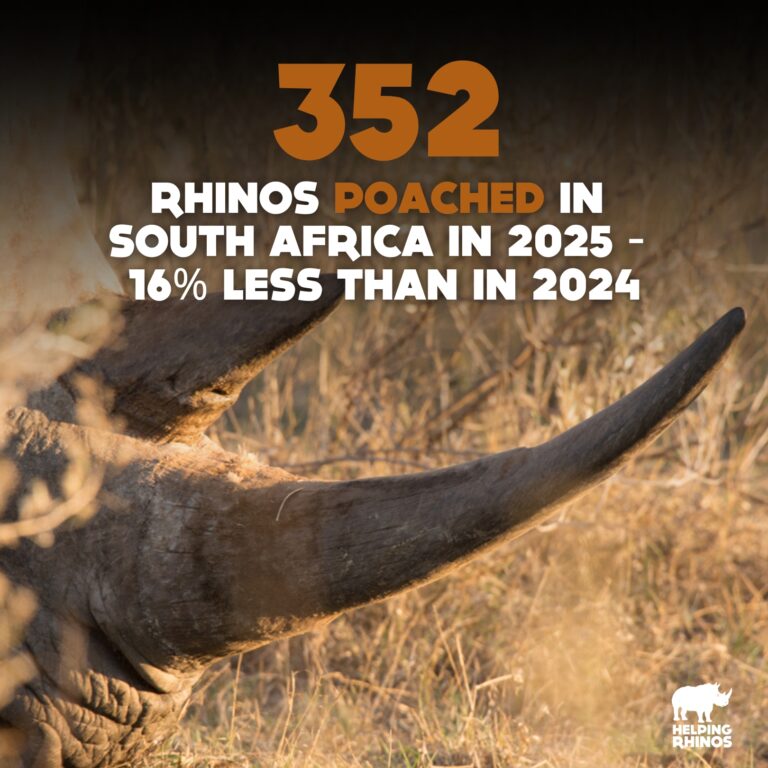
South Africa’s new Minister of Forestry, Fisheries and the Environment Mr. Willie Aucamp has announced that 352 rhinos were poached in South Africa in 2025. This is 68 less than were lost in 2024 and represents a 16% decrease.
This is now the second year in a row that poaching numbers have decreased across South Africa, showing signs of steady progress in the fight against poaching. While these are encouraging numbers, there remain plenty of caveats to these headline stats, including that these figures were once again given without the context of population numbers, and as such it remains difficult to gauge the true impact of these losses.
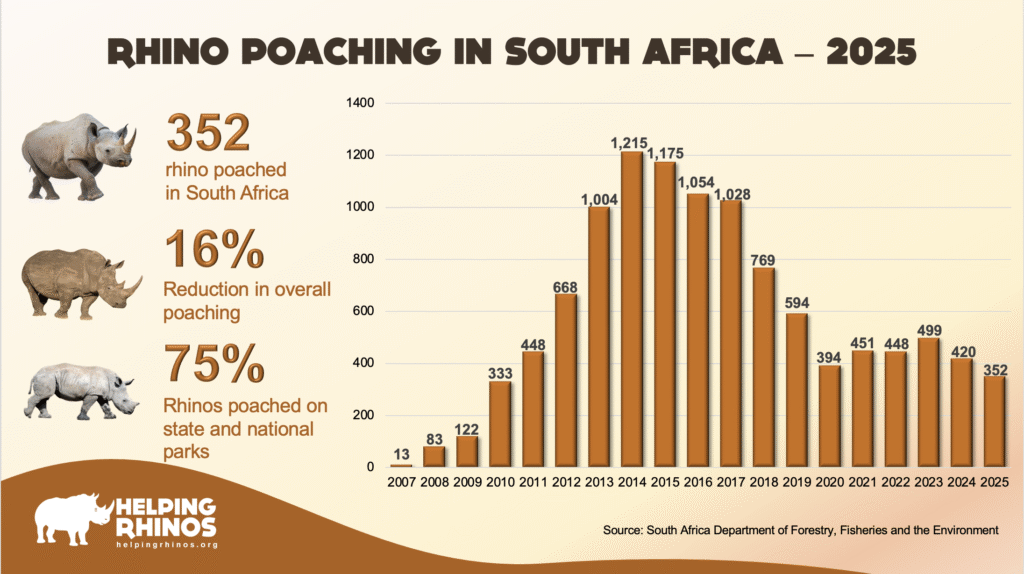
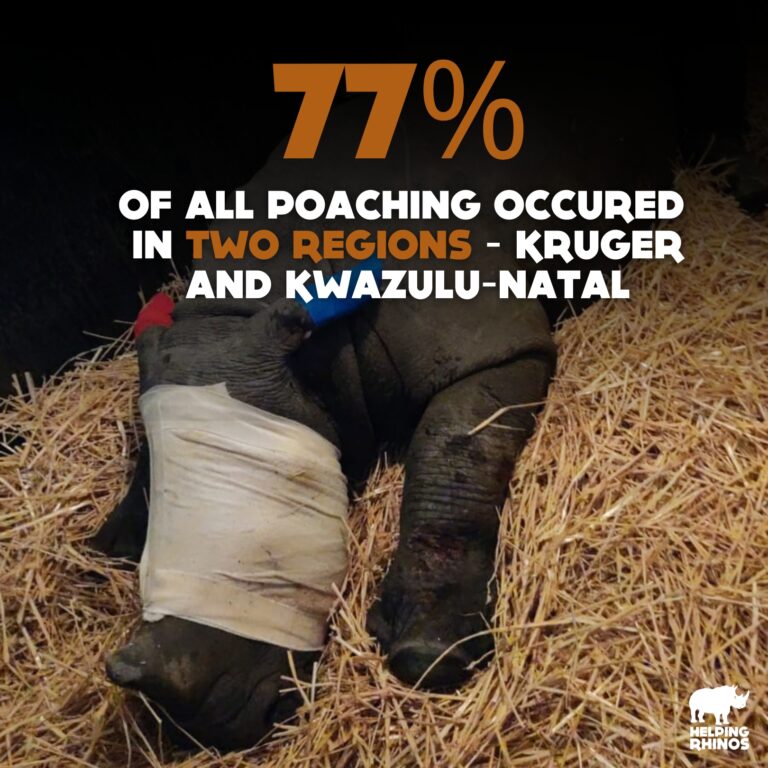
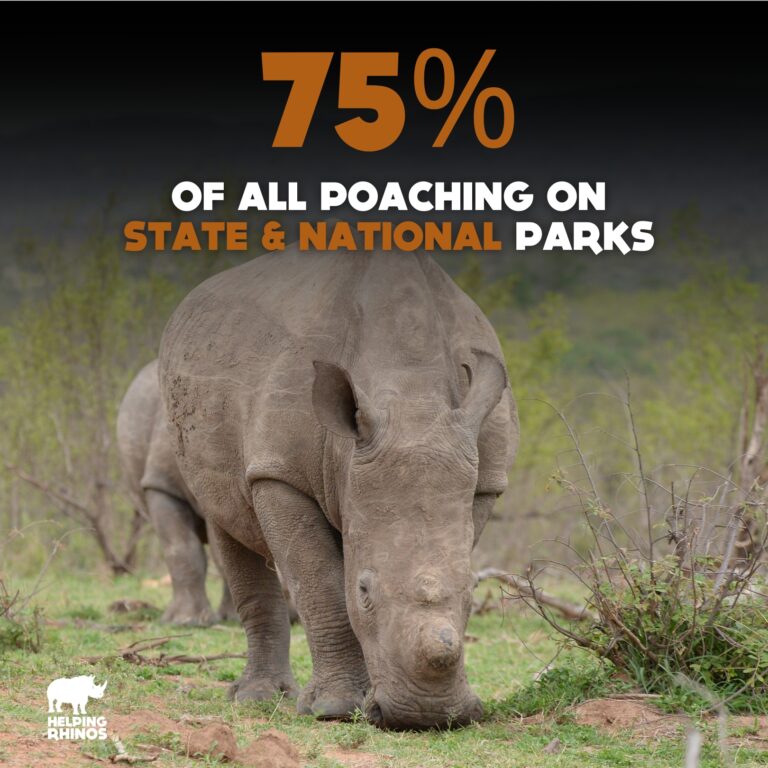
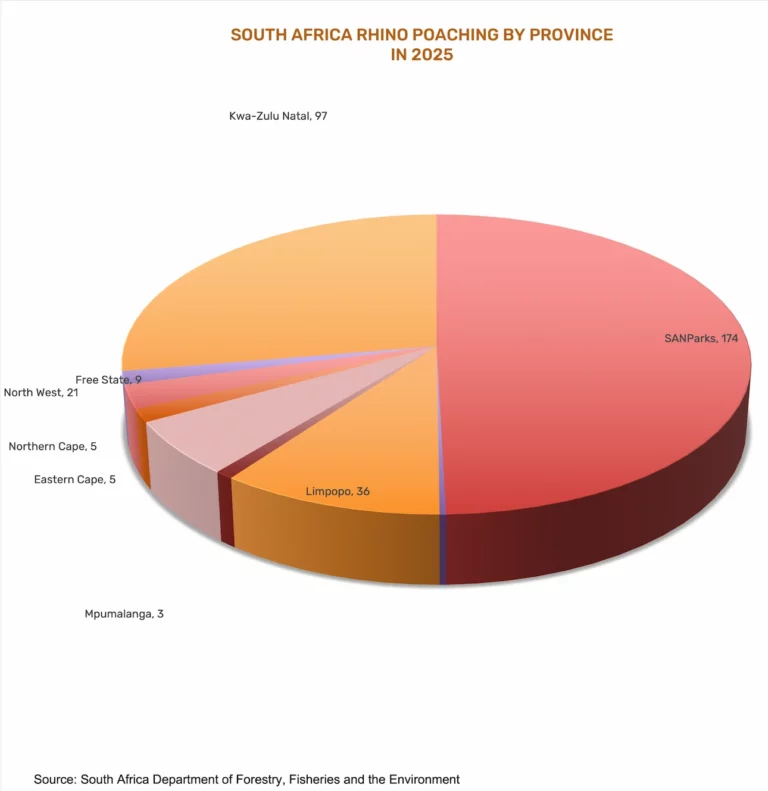
Again, private rhino custodians went above and beyond to hold the line, with just 25% of poaching happening on privately owned land, as opposed to the 75% seen in State and National Parks. Much of this was due to a concerning uptick in poaching within the world-famous Kruger National Park. In 2024 just 88 rhinos were lost, and hopes were high that ongoing anti-corruption efforts were yielding results for the imperilled park. However, the numbers for 2025 show that 175 rhinos were killed by poachers within the park’s boarders, accounting for almost 50% of all rhinos lost.
It seems that the spikes and dips in KZN and KNP are not exclusive. We can assume that the poachers are organised and mobile. This is most likely displacement due to law enforcement pressure. It shows us that this is a national problem and not a local and provincial issue. It will require interprovincial co operation and national intervention. Rangers are buying time for the rhinos, but we need the international trade to be brought under control. Porous borders and corruption must be addressed.
In stark contrast was the turn around seen in KwaZulu-Natal following a concerted dehorning programme within Hluhluwe-iMfolozi National Park during 2024, alongside integrity testing and enhanced early-warning capabilities. Just 97 rhinos were killed by poachers in 2025, 135 less than the year before. While this is hugely encouraging news for the historic stronghold of the southern white rhino, there are fears that poachers may now be diverting their attentions back to privately owned reserves within the Province. This situation is something we are directly monitoring and working to counteract with our leadership teams in the region.
Outside of KZN and Kruger many other Provinces maintained low poaching records, including the Eastern Cape, home to one of our key Rhino Stronghold locations. The presence of our Eyes in the Sky aerial anti-poaching patrols and the fitting of close to 100 cutting-edge rhino tracking devices alongside other regional anti-poaching operations, are playing a key role in keeping the regions’ globally important rhino population secure.
It is encouraging to see a year on year decline in rhino poaching in South Africa, a fact that is testament to the dedication of every person working in rhino conservation around the world, and in particular the commitment of the inspirational Rangers working in the field. I would like to thank all of our supporters who contribute to our work. Despite the welcome reduction in poaching, we must remain vigilant. We are still losing almost one rhino a day and this is unacceptable. I also continue to urge the South African Government to release national rhino populations so that a true assessment on rhinos poached as a percentage of the overall population can be analysed.
Progress like this is hard-won and only achieved with steady work, but we know that it can be taken away in a moment. Therefore, while we celebrate and acknowledge this achievement, we will use this momentum to push further for rhinos and continue to bring this figure down.
HOW YOU CAN HELP
Overall, this is a positive sign for rhinos and a testament to the work being done to keep rhinos safe. But it is only possible thanks to you. Your support is helping us turn the tide for rhinos and see a consistent decline in poaching year on year. 352 is still too many, but steady progress is being made. Please donate today and help us ensure this downward trend continues.
Click here to read the full media release from the South African Government